
TWO:
THREE:A Commission had been appointed to inquire into the Department of Naval Affairs. The Commissioners, at whose head was Mr. Whitbread, had extended their researches so far back as to include the time when Lord Melville, as Mr. Dundas, had presided over that Department. They there discovered some very startling transactions. Large sums of money had been drawn out of the Bank of England on the plea of paying accounts due from the Naval Department; these sums had been paid into Coutts's Bank in the name of the Treasurer of the Navy, Mr. Trotter, who, for long periods together, used these sums for his own benefit. Other large sums had been drawn in the name of Dundas, and had been employed for his profit. Other sums had disappeared, and there was no account showing how they had vanished; but these were scored under the name of Secret Service Money, and Melville declared that the money paid into his account had gone in the same way. As much as forty-eight thousand pounds had been paid over to Pitt at once, and no account given of its expenditure. Indeed, as Pitt had nothing to do with that Department, the payment to him was altogether irregular. These discoveries created a great sensation. George Rose, who had begun life without a sixpence, but who, after attracting the attention of Pitt, had rapidly thriven and become extremely wealthy, had confessed to Wilberforce that some strange jobs had come under his notice as a member of that Department. There was a loud outcry for the impeachment of Melville. Melville appears to have been a jovial, hard-drinking Scotsman, of a somewhat infidel turn, according to Scottish philosophy of that period. Amongst Melville's faults, however, it does not appear that he was of an avaricious character, but rather of a loose morale, and ready to fall in with the licence practised by the officers of all departments of Government in the duties entrusted to them.As the Government was determined to persevere, and to carry the Reform Bill by means of a large creation of peers, if necessary, some of the leading members of the Opposition in the Upper House began to think seriously of their position, a sort of appeal having been made to them in a letter from the king's private secretary, suggesting the prudence of compromise and concession in order to save his Majesty from the painful alternative of a creation of peers. Accordingly, Lords Wharncliffe and Harrowby put themselves in communication with Lord Grey, and this fact was announced by the former in a letter to the Duke of Wellington, stating that he entertained good hope of being able to arrange such a plan of compromise as would prevent the necessity of a second rejection of the Bill by the Lords, and so enable them to alter and amend it when it came into committee. The Duke, in reply to this, said that he was glad of a possibility of an arrangement by mutual concession on the Reform question; and that, for his part, all that he desired to see, under the new system, was a chance of a Government for this hitherto prosperous, happy, and great country, which should give security to life and property hereafter. "The political unions," he said, "had assumed an organisation which any man who could read would pronounce to be for military purposes, and nothing else." In the meantime Lord Wharncliffe had waited by appointment upon the Prime Minister at his house, in Sheen, where he discussed the Reform question with him for two hours, without ever adverting to the political unions, and he reported the issue in a long letter to the Duke of Wellington. The result was that Lord Grey made some trifling concession in matters of detail, and in return Lord Wharncliffe gave him the assurance that he would do what he could to bring the Opposition lords to take a more favourable view of the Ministerial scheme and its probable consequences. This was followed by cordial shaking of hands, and[346] permission was given on each side to communicate with intimate friends and colleagues. The Duke of Wellington, however, declined to take any part in these deliberations. He believed that the Government could be carried on, though with difficulty, under the existing system; but under the system which the Reform Bill would introduce he doubted if the Government could be carried on at all. Nothing came of Lord Wharncliffe's negotiation with the Government, which declined to make any material concession. It had the effect, however, of splitting the Conservative party in the Upper House, breaking the phalanx of the Opposition, and thus preparing the way for the triumph of the Government.
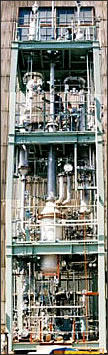
High quality is being demanded in many fields nowadays and so in order to satisfy that we developed a high-purity distillation system in collaboration with Ube industries, Ltd. and Kanto Chemical Co., Inc. The system is used to refine cleaning solutions for the semiconductor industry, medical materials, etc. of high purity (residual ion concentration: 0.01 to 1.0 ppb).
- Our High-purity distillation system provide our clients with high solvent recovery rate, almost 100%.
- The quality of the products/output from our system is very stable, which makes production management very easy, and easier than the conventional ion exchange resin method.
- No emission of waste brings our clients reduction of running cost for environmental measures.
- Our various devices minimize entrainment.
- To prevent the elution of metal, you could ask us the system made of Teflon.
- Our High-purity distillation system has been already proved for solvents that trigger very rapid decomposition reactions, such as hydrogen peroxide.
- Product guide
- Alcohol distillation
- Distillation equipment
- High-purity distillation system
- Membrane separation type solvent dehydration system
- Reactor
- Evaporative concentration equipment
- Coulter spray dryer
- Microwave treatment system
- Filter dryer
- OS filter (continuous vacuum rotating filter)
- Hydrocyclone (liquid cyclone)
- Thermal oil heater (heat medium boiler)
- Process air heater (air heater)
- Ammonia treatment system
- Catalytic deodorizing equipment for ammonia and VOC gas
- Stationary cryogenic storage tank
- Portable cryogenic container
- Cryogenic liquefied gas evaporator